
Inside the Towns County Most Wanted Program
The Towns County Sheriff's Office maintains an official Wanted Persons page. It is the only local public warrant list found in the research. The page presents a selected set of people associated with active warrants, but it does not call itself a full county warrant database. A court record or direct sheriff response remains the better source for a present status decision.
This resource describes and links the official program. It does not copy names, dates of birth, photographs, or any roster. That boundary matters because a copied list can go stale as soon as a warrant is served, recalled, or otherwise changed. Readers should consult the sheriff's own page and follow its caution against taking physical action.
The official sheriff source shows the Towns County wanted-page interface without requiring this civic reference to host its roster.
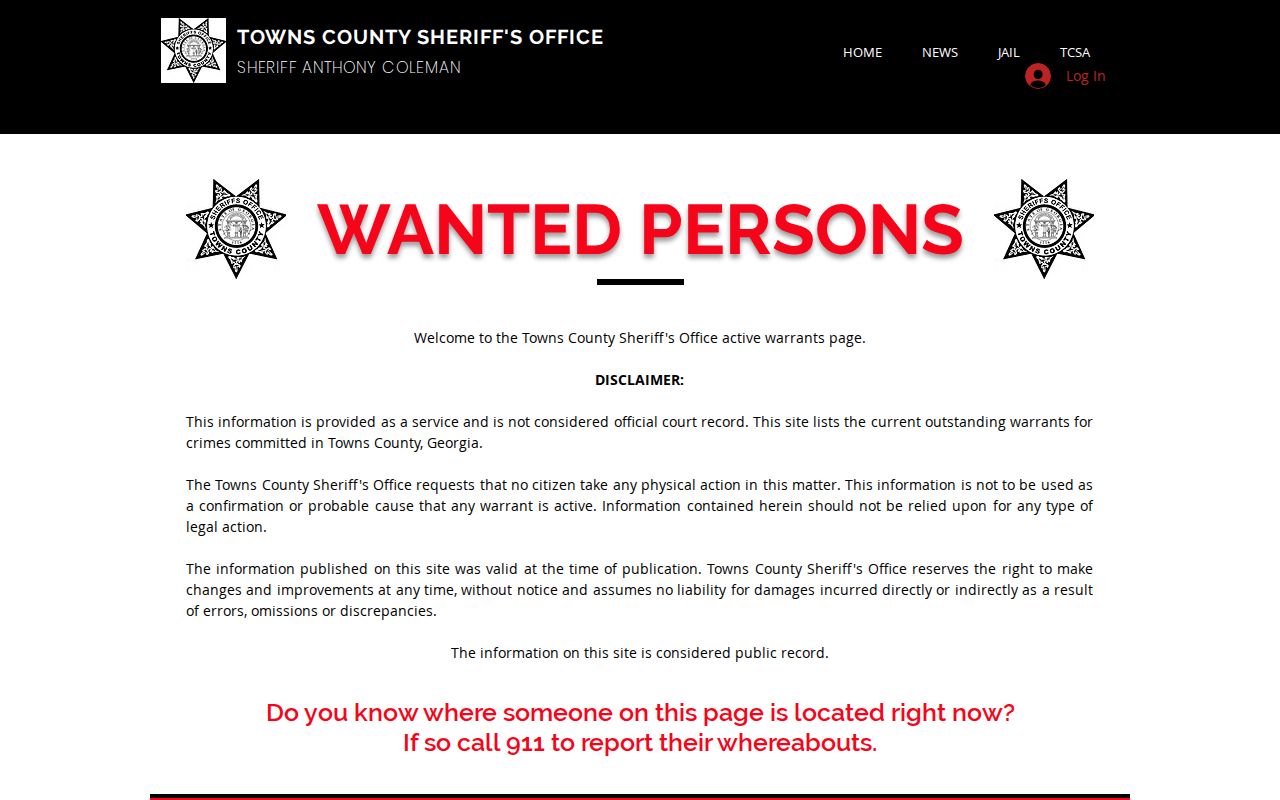
The captured interface reinforces both limits: check the live source and treat its disclaimer as part of the record.
Towns County Wanted Page Fields
The public interface exposes only a small schema. Research observed labels for a name, nickname or alias, date of birth, and an “Active Warrant?” indicator. It did not show a warrant number, charge, bond amount, issuing court, issue date, status date, filter, export tool, or search box. No values from the roster are reproduced here.
- Name and alias
- Identity labels shown by the sheriff, which still require care when names are similar.
- Date of birth
- A matching field on the official page, not permission to copy or redistribute a personal record.
- Active Warrant?
- The page's brief status label, subject to its non-official-record disclaimer.
The narrow set of fields explains why the page cannot replace a clerk's case file. The Towns County Superior Court clerk or other issuing court can identify the case behind a warrant, while the sheriff can address service and custody status.
How Towns County Most Wanted Lists Work
A most-wanted page is a curated publication. It is not the full set of unserved Towns County warrants. The sheriff decides what the public page displays, and the visible list may change after an arrest, surrender, recall, or other case action. Research found no posted refresh schedule, “as of” time, pagination, or archive.
The page itself warns that it is not an official court record and should not confirm that a warrant remains active. That warning cuts both ways. A displayed item may lag a later court action, while a person with an active warrant may never appear on the public page. A direct call to the sheriff at 706-896-4444 and confirmation from the issuing court are safer than drawing a conclusion from presence or absence alone.
Key point: The Towns County list is a public lead, not a complete or court-certified active-warrant index.
Towns County Most Wanted Tips
The sheriff maintains a separate drug and crime tip form. That channel is for sending information, not checking whether a warrant exists. It asks for facts such as the date, location, vehicle details, and a description. An optional image or video may be attached, with a documented upload limit of 15 MB.
The sheriff also lists an anonymous tip line at 706-896-3697. Research did not locate a published reward schedule, a promise that every tip stays anonymous under all circumstances, or a local Crime Stoppers reward arrangement. Those details should not be inferred. A useful tip sticks to facts the caller directly observed and avoids guesses about identity or guilt.
The sheriff's official tip page displays the prompts and upload route used for Towns County reports.
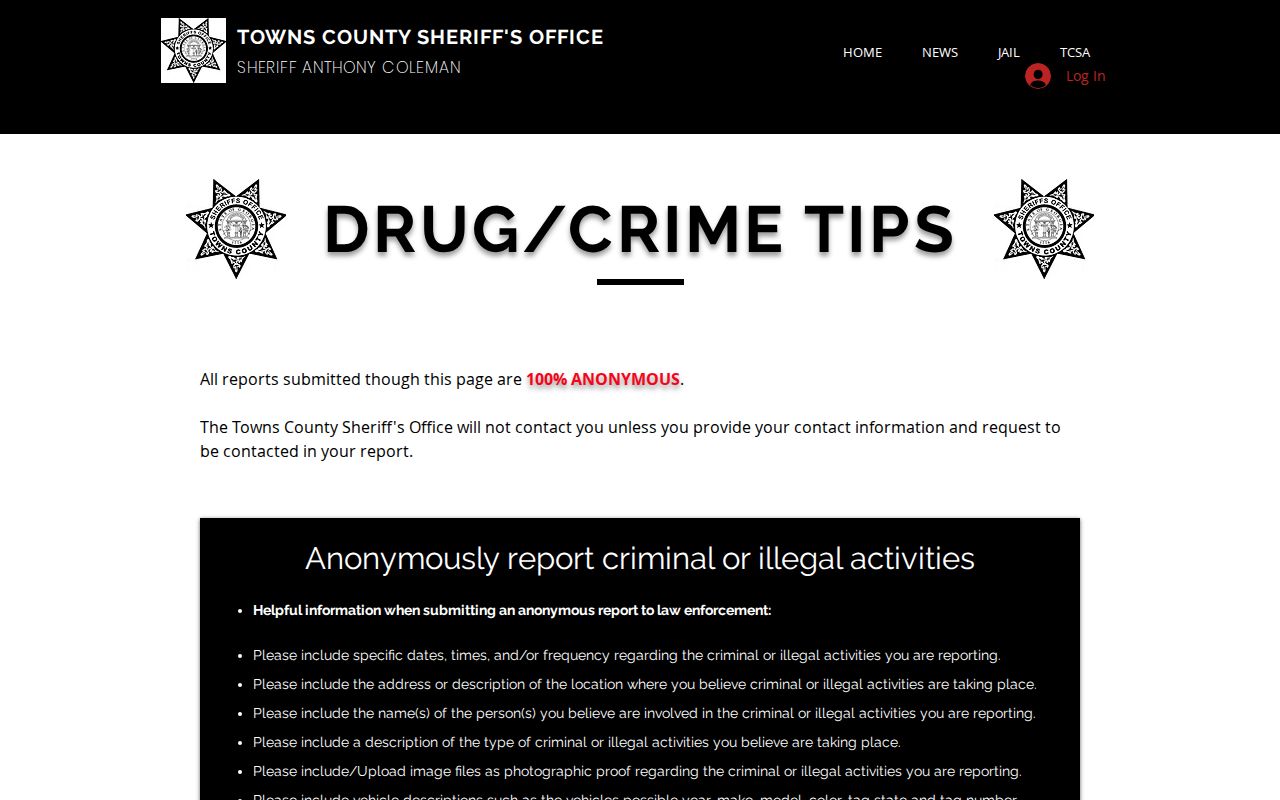
The form is a reporting channel only; it does not return warrant status or replace a call to the court.
For an emergency or an event in progress, call 911. Towns County non-emergency dispatch at 706-896-7460 operates around the clock, but it is an agency-routing service rather than a warrant records counter.
Sending a Most Wanted Tip Safely
Public participation ends with reporting. Do not follow, stop, question, or detain a person based on a web page. The sheriff's own disclaimer says citizens should take no physical action. A current location or immediate safety risk belongs with trained dispatchers.
- Choose 911 for an emergency, or use the sheriff's tip form or anonymous line for non-emergency information.
- Give the location, time, vehicle, direction of travel, and other facts observed firsthand.
- Do not upload or send private material that has no clear link to the tip.
- Step back and let Towns County law enforcement decide how to respond.
Safety boundary: Report useful facts, keep a safe distance, and never try to make an arrest or serve a Towns County warrant.
Towns County Wanted List Limits
The Wanted Persons page and a certified court record answer different questions. The sheriff publication tells the public what the agency chose to post. Eric Barrett, Clerk of Towns County Superior Court, keeps Superior Court criminal files. Hiawassee Municipal Court keeps its city cases, and the Towns County Magistrate/Probate office addresses its own lower-court work.
A person researching their own case should identify the issuing court before asking for details. Superior Court clerk contact is 706-896-2130. The Magistrate/Probate office uses 706-896-3467. Hiawassee Municipal Court routes questions through City Hall at 706-896-2202. Each office may hold facts that are absent from the sheriff's brief public schema.
Georgia has no public statewide warrant search that fills these local gaps. The practical chain is the Towns County sheriff for warrant service or custody, then the named court for the underlying case and any recall order.
How Most Wanted Differs From an Active Warrant
Every item on a properly maintained wanted list should relate to an agency concern, but most active warrants are not posted as “most wanted.” The distinction is publication, not a separate kind of warrant. A judge issues the legal process; the sheriff chooses what to feature publicly.
| Feature | Most-wanted page | Active warrant record |
|---|---|---|
| Scope | Selected public entries | Any warrant still legally in force |
| Record holder | Towns County Sheriff's Office page | Issuing court and serving agency |
| Public detail | Only the displayed schema | Case facts depend on access law and court record |
| Confirmation | Not certified by the page | Ask the sheriff and issuing court |
The Towns County active-warrant explanation covers the broader status question. Neither category authorizes a member of the public to confront anyone.
Towns County Wanted Update Timing
No update cadence or status timestamp was visible during inspection. The sheriff site also carries older site-footer material while its current home page identifies present leadership. That mix is a reason to verify a contact or status by phone before relying on it.
The lack of a timestamp is not proof that the list is neglected. It simply means a reader cannot measure its age from the interface. A fresh court order can change warrant status without the public page changing at the same instant. The issuing court's docket, a clerk response, or direct sheriff confirmation can provide the needed context.
Federal warrants are outside the scope of this county publication. Federal court records route through the Northern District of Georgia and PACER, while the U.S. Marshals Service handles federal fugitive work. A local list should not be read as a national or statewide index.
When You Believe You Are Listed
Do not use the tip form to ask about your own warrant. Contact an attorney, the Towns County Sheriff's Office, and the issuing court through a planned route. An attorney can help confirm the legal process, learn whether bond is set, and discuss a voluntary surrender or court motion. Calling the sheriff directly may lead to custody, a point also reflected in Georgia's county-sheriff warrant guidance.
If surrender or booking is required, the Towns County Detention Center is at 4070 GA Highway 339 in Young Harris, and its number is 706-896-5474. The official jail page provides the current bond-window and detention information. Do not arrive based only on a copied address or an old directory; call first and follow counsel's advice.
Important: Confirm your own Towns County warrant through counsel and official offices before arranging surrender, payment, court appearance, or bond.
Towns County Most Wanted Access Rules
The Georgia Open Records Act, O.C.G.A. §§50-18-70 et seq., governs many agency records, subject to exemptions and court-record rules. The sheriff accepts requests through its Open Records page, by the linked form, email routes, mail, or hand delivery. A request should identify the desired record and date range clearly.
Open-records access does not turn every warrant into a public online listing. Newly issued process, sealed matters, juvenile records, protected investigative material, and records held by another court may be restricted or unavailable. The office may respond with available records, cite an exemption, or explain that another custodian holds the file.
Use an open-records request for a defined sheriff record, not as an emergency warrant check. Current status still calls for the sheriff's main line and the issuing court. That route respects the difference between a public list, an agency record, and the court order itself.